
What Canvassing Taught Me About Major Gifts

Updated: May 31
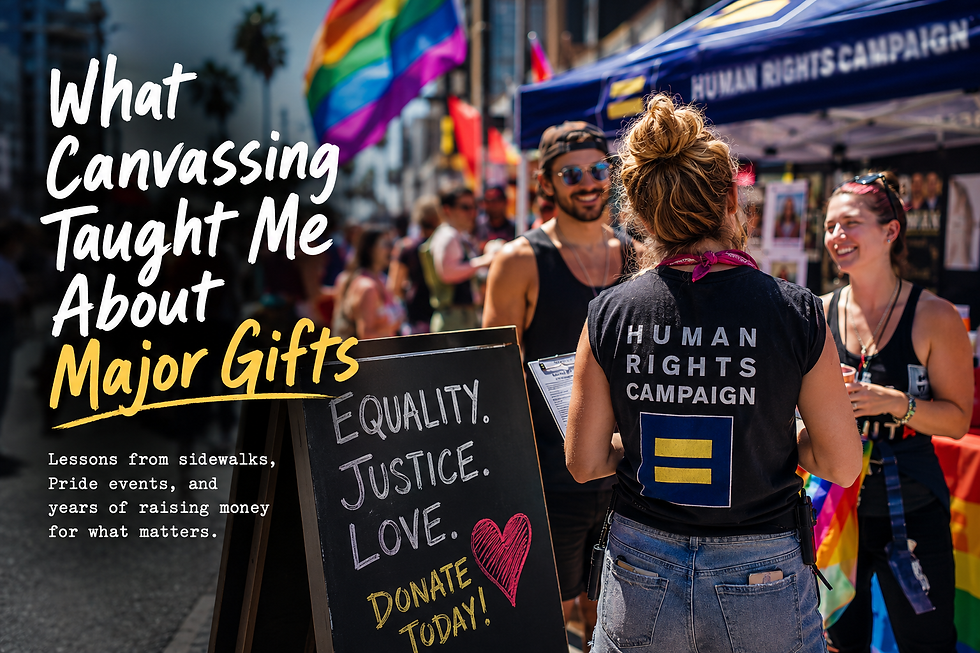
I've lost count of how many Whole Foods and REI stores I've stood in front of over the years.
Before I became a major gifts officer, Development Director, and fundraising consultant, I spent years raising money face-to-face for movement organizations working on environmental issues, LGBTQIA rights, consumer advocacy, and other causes I cared deeply about. My office was often a sidewalk, a grocery store entrance, a street corner, or a community event.
When I lived in Los Angeles, one of our regular canvassing locations was the Crunch Gym in West Hollywood. It was also apparently a gathering place for celebrities. Over the years I spotted Mark McGrath from Sugar Ray, Rashida Jones, and a rotating cast of actors whose names I never knew but whose faces I recognized from somewhere.
Every day I approached complete strangers and tried to connect around something that mattered. Sometimes those conversations lasted thirty seconds. Sometimes they stretched longer. Most ended with a polite no, some ended with a donation.
My favorite shifts were always Pride events for the Human Rights Campaign. The music was loud, the crowds were enormous, and by the end of the day I could barely speak because I'd spent hours trying to have conversations over pounding technopop. I'd go home exhausted, hoarse, and completely energized at the same time.
Fundraising doesn't get talked about this way very often. In nonprofit spaces, we tend to focus on the discomfort, the pressure, and the anxiety that can come with asking for money. Those things are real, and I've certainly experienced them myself. But I also found fundraising genuinely fun.
I think that's one of the reasons I stayed with it. Every conversation was a puzzle. Every donor was different. Every day brought new surprises, new stories, and new opportunities to connect with people who cared about the same things I cared about. There was always something to learn.
I loved meeting people who cared about the same issues I cared about. I loved the challenge of figuring out what motivated different people. I loved the strategy of it. And I loved the feeling of helping someone take a step from agreement to action.
There's a particular feeling that comes when someone says yes after a great conversation. Anyone who has raised money knows exactly what I'm talking about.
One of my favorite parts of the job was training new fundraisers. Almost every new fundraiser started in the same place. They were nervous. They were convinced people would reject them. They worried they would say the wrong thing. Many were certain they simply weren't cut out for fundraising.
Then they'd have their first real conversation, make their first ask, and get their first gift. The transformation was immediate.
They realized fundraising wasn't some mysterious talent that other people possessed. It was a skill. Like any other skill, it improved with practice.
I spent years training hundreds of people to do this work, and I saw the same pattern over and over again. The people who succeeded weren't necessarily the most charismatic. They weren't always the loudest or most outgoing. They were the people who stayed present, listened carefully, recovered quickly from rejection, and kept showing up.
One of those canvassers eventually became my husband.
At the time, he was running the door-to-door office and I was running the street fundraising office. We were both competitive, both deeply committed to the work, and both trying to raise as much money as possible for the organizations we represented.
We competed constantly, and I'm pretty sure I won. He may remember differently.
We were roommates before we were anything else, mostly because the rent was too high for either of us to afford on our own. Somewhere between fundraising goals, organizing conversations, long workdays, and a shared apartment, a relationship developed.
A real movement romance. We still compete sometimes. We also remain each other's biggest cheerleaders.
I've thought about that chapter of my life a lot over the years because some of my closest friendships, my professional community, and even my marriage grew out of movement work and the relationships built through it. The work taught me how to be curious about people, how to listen, how to find common ground quickly, and how to invite someone into something bigger than themselves. Those are still some of the most important skills I use as a fundraiser today.
Years later, when I became a major gifts officer, I was surprised by how familiar the work felt.
I found myself drawing on many of the same muscles I had developed on sidewalks, at Pride events, and outside grocery stores. The gift amounts were dramatically different. Instead of asking for monthly gifts outside Whole Foods, I was sitting down with donors and discussing gifts in the tens of thousands of dollars. The meetings lasted longer, happened in quieter settings, and came with more preparation, but the underlying dynamics felt remarkably similar.
People wanted to be heard. They wanted to talk about what they cared about. They wanted to invest in things that reflected their values. And just like the people I met outside grocery stores, they couldn't say yes to an opportunity they were never asked to consider.
That lesson showed up again recently while working with Texas Gun Sense.
One donor had a history of giving around $20,000 annually. As we looked at the relationship, the donor's engagement, and the opportunity in front of them, we encouraged the team to think bigger. They ultimately asked for $50,000.
The donor said yes.
What stands out to me about that story is how ordinary it is. There wasn't a secret technique. Nobody used a clever script. The team simply had the courage to make an ask that reflected the donor's level of commitment to the work.
Here's the case study, if you'd like to learn more. I've seen versions of this story play out for most of my career.
Sometimes the missed opportunity isn't a lack of donors. Sometimes it's a fundraiser deciding in advance what someone will or won't do. We tell ourselves a gift amount is too ambitious. We assume someone isn't interested. We convince ourselves now isn't the right time. Then we lower the ask or avoid the conversation altogether.
The people who consistently raise the most money aren't necessarily the most charismatic or persuasive. They're the people who stay curious, listen carefully, ask directly, and keep going when they hear no. Over time, I've become convinced that fundraising has far less to do with talent than most people think and far more to do with practice.
The dollar amounts change, but human beings don't. That's one of the reasons we created our guide, Donor Scenarios and Guiding the Conversation.
Many leaders assume strong fundraisers always know exactly what to say. In reality, donor meetings are often messy, unpredictable, and deeply human. Donors arrive with different personalities, communication styles, questions, anxieties, and expectations. Movement fundraising adds another layer of complexity because conversations often drift into organizing strategy, coalition dynamics, electoral work, policy debates, or broader movement conversations. Strong fundraisers learn how to stay grounded, lead conversations intentionally, navigate difficult moments, and keep meetings moving toward investment and clear next steps.
If donor conversations sometimes feel harder than they should, start there.
And if you're ready to build a more intentional major gifts program, our Major Gifts Accelerator helps leaders develop those skills in practice. We work alongside Executive Directors and development leaders to identify priority donors, prepare for meetings, make stronger asks, and build the systems and habits that turn donor relationships into meaningful investment.
After all these years, that's still what I love most about fundraising. It's an opportunity to connect with another person, talk about something that matters, and invite them to help build the future they want to see.


