The Accidental Fundraiser: Why Executive Directors Already Have What It Takes


Most Executive Directors are accidental fundraisers.
They didn't set out to build careers in fundraising. They became organizers,
advocates, attorneys, communicators, educators, researchers, policy experts, and movement leaders. Then one day they inherited a donor portfolio and were expected to know how to raise major gifts.
I've spent nearly two decades working alongside Executive Directors, and the leaders who feel most uncertain about fundraising are often the strongest leaders everywhere else. They navigate board conflict, lead campaigns, explain complicated policy issues, and build powerful partnerships. Then fundraising enters the picture, and suddenly they're expected to lead one of the organization's most important revenue functions with very little preparation.
Fundraising feels like a different profession. In reality, it builds on many of the same instincts that make someone an effective organizer.
Organizing is about understanding what people care about, building trust, connecting individual interests to a shared vision, and inviting people to take meaningful action. Fundraising asks people to invest financial resources in that same vision. You're still building relationships. You're still listening. You're still helping people see the role they can play in creating change.
You can usually tell when fundraising feels unfamiliar. Donor meetings sink to the bottom of the to-do list, partly because they create anxiety and partly because nobody is waiting for them. A grant deadline shows up on the calendar. An event has a fixed date. A board meeting happens whether you're ready or not. Donor conversations rarely come with that kind of external accountability, so they become easy to postpone until next week, then next month.
Leaders either spend hours overpreparing or walk into meetings hoping for the best because they don't know what preparation should look like. Follow-up becomes inconsistent. Gift amounts feel uncomfortable to discuss, or never get discussed at all. Organizations start looking for new donors while existing supporters wait for someone to build a deeper relationship.
Many leaders also feel far more comfortable talking with foundations than individual donors.
Foundation program officers often built their careers inside nonprofits or movements before moving into philanthropy. They speak the same language, understand the policy landscape, and share many of the same reference points. They can certainly feel intimidating because they hold significant influence, but they still feel like people from our world.
Individual donors are different. They may have built businesses, worked in finance, healthcare, technology, or another field entirely. They don't necessarily share your career path or your day-to-day experiences. Building authentic relationships across those differences is a skill, and it's one that very few nonprofit leaders are ever taught.
If this feels familiar, we created a free guide called Donor Scenarios and Guiding the Conversation. It walks through common situations Executive Directors encounter and how experienced fundraisers navigate them. It's designed to help leaders prepare for donor meetings with greater confidence and leave them with clear next steps.
One Executive Director I recently worked with reminded me why this matters.
She led an organization in the early learning and leadership development space. She was deeply thoughtful, an introvert by nature, and a researcher who liked to move deliberately. She cared deeply about her organization and the people it served, but making fundraising asks felt uncomfortable.
As we worked together, she never tried to become someone she wasn't.
She didn't suddenly become outgoing. She didn't force herself into approaches that felt unnatural. In fact, she didn't follow every piece of tactical advice I offered, and that was completely fine.
Instead, she built a fundraising approach that matched who she already was. She prepared carefully, practiced consistently, and learned through experience.
Near the end of our engagement, we met over Zoom while she was sitting in a library. She leaned toward the camera like she was sharing a secret.
"The donor invested $20,000."
Then she smiled and said something I'll never forget.
"See Robin, I was listening. I just needed to do it my way."
She found a fundraising approach that fit her personality, her values, and the relationships she wanted to build.
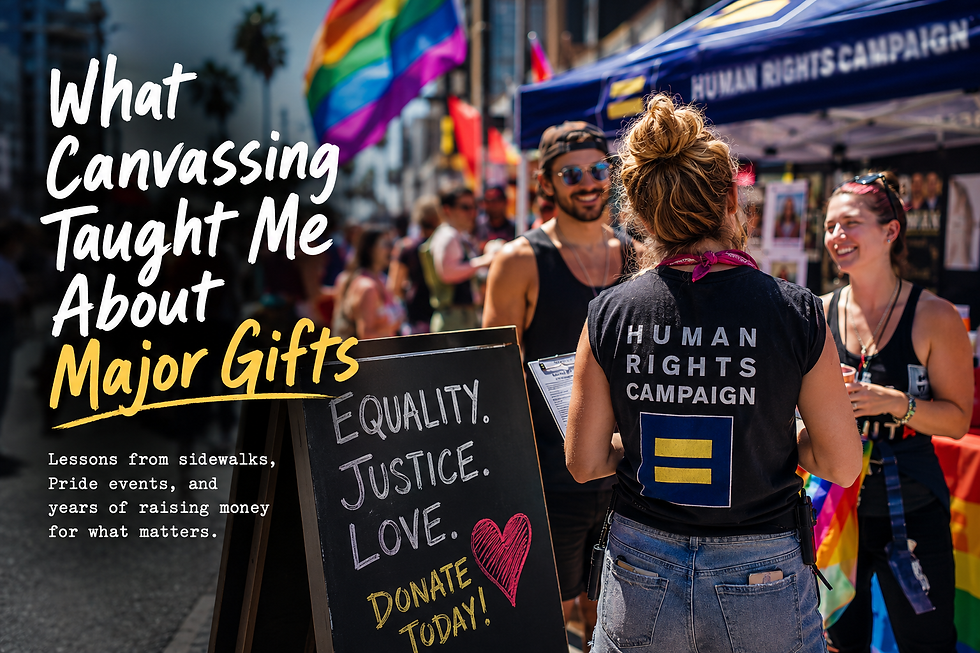
That experience reinforced something I first learned years ago while training canvassers. Successful fundraisers don't all share the same personality.
I've worked with charismatic leaders who could light up every room they walked into. I've also watched thoughtful introverts build extraordinary donor relationships because they listened carefully, prepared well, and made donors feel genuinely heard.
There isn't one right way to build meaningful donor relationships.
When leaders avoid donor conversations because they feel underprepared, opportunities go unfunded, major gifts stay smaller than they could be, and organizations spend more energy managing scarcity than building power. Helping Executive Directors become stronger fundraisers is one of the highest leverage investments an organization can make.
That's why we created the Major Gifts Accelerator.
We work alongside Executive Directors and development leaders as they prepare for donor meetings, strengthen asks, and build fundraising habits that last. Together we practice real conversations, solve real challenges, and develop an approach that fits their leadership style and organization.
You're already an organizer. Fundraising is another expression of that work. It starts with relationships, grows through trust, and gives people the opportunity to invest in the future they want to help create.
The only way to become more comfortable in those conversations is to have them.
If you're looking for a place to begin, download our free Donor Scenarios and Guiding the Conversation guide. And if you'd like a partner as you build a major gifts program, we'd love to talk about the Major Gifts Accelerator.